Showing posts with label Arkansas food history. Show all posts

Wednesday, April 22, 2015

Lost To Time - Browning's Mexican Restaurant.

Browning's Mexican Restaurant as it appeared in the late 1950s.
I'm a Little Rock girl, but my Little Rock memories barely contain anything of adventures to Browning's Mexican Restaurant in the Heights. That may seem a sin to those who regard its influence as a classic amongst Arkansas restaurants. In my defense, I was young, I grew up near Casa Bonita, and when I reached adulthood Casa Manana appeared close by.

But yes, even I have memories of a Saltillo platter at the old standby.  I think that, for a certain set of Little Rock resident, it was something you had to do at least once.

Today, the Heights Taco and Tamale Company opens in the space that housed Browning's for more than 60 years.  I'm sure you've seen the previews... somehow, I didn't make the cut to get in early, but when I do enter the doors as a paying customer, I'll share my experiences.  Before I do, though, I should note the restaurant that managed to imprint itself on Ark-Mex cuisine.

Cheese dip and salsa at Browning's Mexican Grill, 2012.
That cuisine has been a part of Arkansas culture for more than 80 years.  We have good records of Little Mexico, the Donnelly's place in Hot Springs.  You'll remember me talking about Blackie Donnelly, the Irish guy who took his wife to Mexico and brought back the spices they used to create the world's first cheese dip (don't worry, he brought her back, too).  Little Mexico was one of the to-go places for an Arkansas translation of Mexican dishes back in the 1930s.  In West Memphis, Pancho's came along in the 1950s.  In Benton, there was El Cena Casa.

John Tom Browning.
In Little Rock, Browning's started serving in 1946. John Browning and his son-in-law, Boyd Montgomery, opened its doors shortly after the end of the second World War.  It changed hands a few times over the years, but up through the early '00s it managed to maintain a certain flavor and atmosphere.

Ark-Mex food is different from Mexican fare and from Tex-Mex, too.  Ask anyone who's spent a great deal of time in Texas and visited "Mexican" restaurants both here and there.  Cheese dip is a
Boyd Montgomery (on left).
curiosity to those folks.  They don't understand it.  Tex-Mex restaurants put more cilantro and lard in their dishes.  They include more barbecue and chipotle, lots of dry rub and chorizo, and goat is available in some places.  Tamales are pork, often from a pig's head. Chips tend to be thinner.

Ark-Mex food has evolved around the inclusion of cheese dip.  It tends to utilize more pintos than black beans, darker American and Cheddar cheeses instead of white or Mexican cheeses.  Tomatoes are a big part of the equation, fresh and in the salsa.  Tortilla chips are thicker, and there's a prevalence of tamales that include chicken and beef in addition to pork.

When that interpretation was still being worked out, abominations were created.  For some reason, some of our restaurants here never got over the idea of smothering everything, and I do mean everything, in yellow cheese. Casa Viva, the inferior short-lived successor to Casa Bonita, was accused of using Campbell's Cheddar Cheese soup over its enchiladas.  There were waves of interest in different things... nachos in the late 70s, fajitas in the late 80s, quesadillas in the 90s and the fish taco in the 21st century.
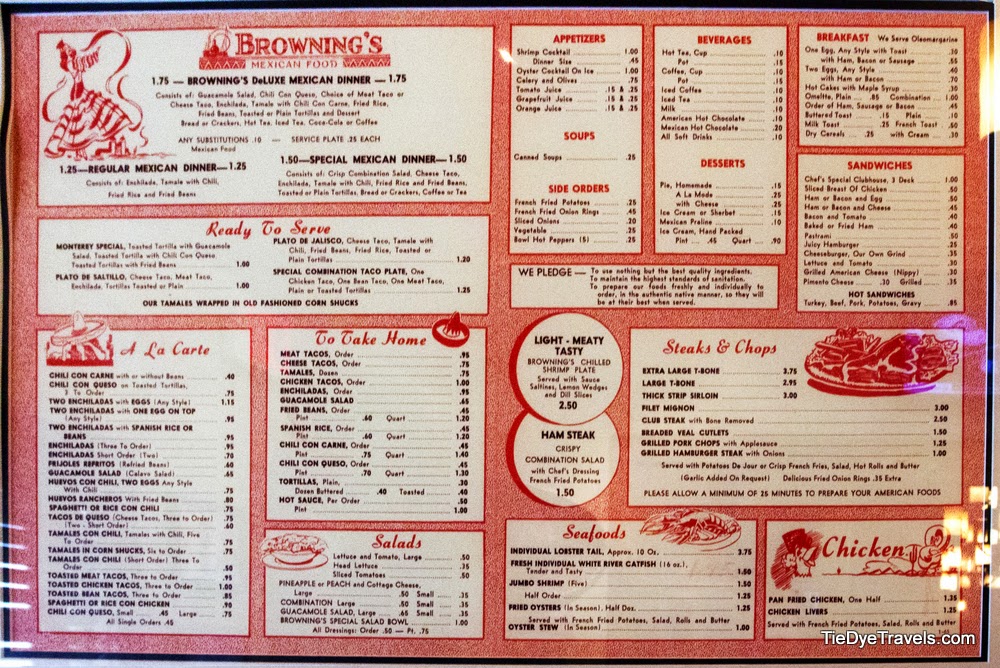
Browning's menu from 1949.
Browning's did cater to a lot of that, even from the very beginning.  Its original Browning's De-Luxe Mexican Dinner included a guacamole salad, chili con queso, a meat or cheese taco (the meat being ground beef), enchilada, tamale covered with chili con queso (also all beef),
Interior in the early 1950s.
fried rice, fried beans, with toasted or plain tortillas.  It also came with bread or crackers, a dessert and a choice of hot or iced tea, Coca-Cola or coffee.  It was all of a grand sum of $1.75.

There were many other things on the menu, as you can suspect.  Don't think this putting an egg on everything idea is
One of the original wall murals painted by Mallie Vena.
new... the 1949 menu offers eggs on enchiladas.  There was "spaghetti or rice con chicken," an appetizer of celery and olives, the three layer "Chef's Special Clubhouse" sandwich, pimento cheese sandwiches and a large selection of steaks. fried chicken, fried oysters, ham steaks and the "LIGHT-MEATY-
Vic Slater once cooked at Brownings.
TASTY Chilled Shrimp Plate" as well as individually fried White River catfish, lobster and peach halves stuffed with cottage cheese.  It even served breakfast.  Browning's, after all, wasn't just a Mexican-esque restaurant; it celebrated Arkansas foods as well and threw in the kitchen sink for good measure.

The famed Plato de Saltillo.

And yes, even on that first menu, there's the Plato de Saltillo, the dish the restaurant would be best known for, a meat taco and meat taco and enchilada, smothered in cheese and served with tortilla chips.  Back then, it was only a buck.

A flyer from 1976.

As the years went by, the restaurant expanded.  Do you recall the location out on Baseline, or on McCain in North Little Rock, or on the "New Benton Highway?" Do you even recall the New Benton Highway?  There was also El Patio on University, which was within my range (yes, my friends, I am originally an 09-er, and if you know what that means, you know what it means) for us to enjoy that pureed "salsa" sauce with yellow chips in a bag that would always develop grease spots.  The Browning's flavor, after all, did make it out of the Heights.

For a city and even a state that remained secluded and mysterious to the rest of the world, Browning's was a treat.  Once the doors opened, and men like Sam Walton, Bill Clinton and the Stephenses managed to get Arkansas spoken of in terms that didn't include "hillbillies," things changed.  Our palates
The Mexirrito, my go-to dish from Browning's.
changed.  And by the dawn of the 21st century, places like Browning's were having a hard time of it.  The restaurant closed in 2010, only to be purchased, renovated and reopened and eventually fail again.

I noticed on the menu for the new Heights Taco and Tamale Company, amongst the offerings, the Plato de 1947.  It includes enchilada, taco and tamale... but it's no Plato de Saltillo.  No, my friends, that sounds like it may be lost to time.

Then again, Scott McGehee, John Beachboard and Russ McDonough's Yellow Rocket Concepts has managed to bring back other original flavors.  Of note is Local Lime's Taco Kid Tuesday, which revives many of the popular items from the old Taco Kid.  Perhaps, once Heights Taco and Tamale Company encounters its first few weeks of customers, we'll see a revival of the dish most associated with the old Browning's.

One way or another, the Browning's known by generation of Little Rock natives is gone for good, only to remain in the memories of those who congregated at its tables.  If you'd like to take a trip down memory lane, the restaurant's last owners have left a Facebook page active that includes many photos from the eatery's early days.


Wednesday, October 16, 2013

Arkansas and its Fading Restaurant History.

Postcard from Best Western Alamo Court and Davy
Crockett Restaurant in Walnut Ridge.
I've been working on a new project over the past nine months… another book, to be exact.  This one was to be an all-encompassing book called Classic Arkansas Eateries:  A Delicious Tradition of Dining Out.  But as I compiled my research, I realized something – 40,000 words wasn't going to do justice to the food and restaurants of The Natural State.  Thus was born Classic Eateries of the Ozarks and Arkansas River Valley, the first of what I expect to be four books covering the classic restaurants all around Arkansas.

I've learned a lot, and I’m expecting to learn a lot more.  The very first thing I learned, though, was that there’s no good repository of information about these older restaurants.  Outside of Little Rock (which, thanks to the Arkansas Gazette and Arkansas Democrat, saved its restaurant history fairly well), little of the restaurants that have closed remains.  Frankly, our Arkansas restaurant history is fading away.

There are a few places to find bits here and there.  Phone books from the past give addresses, names and the number – which is a starting point.  Eateries that had money for advertising are represented in newspapers of the time where archives are available.  There are privately held photos and stories, and there are the extant restaurants that often keep their own history (though, as in the case of the original DeVito’s at Bear Creek Springs, circumstances can erase that memorabilia).  And then there are the postcards.

Hank's Dog House on Roosevelt Road in the 1960s.
The average restaurant, diner, drive-in or coffeeshop wasn’t likely to have its own postcard unless it was part of a hotel or if its owner was looking for publicity and good word-of-mouth.  Postcards cost money.

There were dozens of companies all across the United States that would create postcards and send them to these restaurants for a nominal fee.  Often these were sold at the register – for a nickel, three for a dime – add a stamp and off went a memory shared with someone back home.

Today postcards are swapped, sold and traded on sites such as eBay and CashCow.com.  Many have made their way into historical records and private collections.  And what I’ve discovered is a preserved history.

Back when I started working with photographer Grav Weldon, what each of us shot wasn’t very similar.  Grav’s preferred body of work is entropy – gravesites and cemeteries, abandoned buildings, that sort of thing.  Mine?  Well… food, of course.  Over time we’ve found some of our work merging – especially when it comes to this restaurant business.  And now I’m really starting to feel this call – this entropy of lost places that once fed communities.  It’s important.  These sort of places deserve to be remembered.

Shadden's Bar-B-Q in Marvell, August 2013. (Grav Weldon)
One of these images came this past summer.  On a research trip through the Arkansas Delta, I drove Grav by Shadden’s Bar-B-Q in Marvell.  Three years earlier, Mr. Wayne Shadden wasn’t feeling good, so he shut down for the day and went home.  The next day, he died – and the restaurant remains as it was.  I was surprised how well kept the exterior is – but the family’s watching over the place.  Most places aren’t so lucky… just see what happened to the smokehouse at Booger Hollow within a year of its closing.

Scrapping together history like this starts with a little logic.  I have images of several postcards in my collection.  Part of the new book talks about the history of The Old South in Russellville – and its predecessors.  The modular site-assembled restaurant idea created by William E. Stell at National Glass Manufacturing in Fort Smith apparently took hold.  There were hundreds of the buildings placed in locations all over the United States.  At least two of them were in Little Rock -- under the name Gordon Adkins' Fine Foods.
Gordon Adkins No. 1 on Roosevelt Road.

The restaurants had to have come after 1946 (the date the first location of The Old South was opened in Fort Smith) but before Hank’s Dog House.  I’ll get to that.  What we have of the first Gordon Adkins is not a photograph but a line drawing, complete with an address of 3614 Roosevelt Road.

Hank's Dog House in the 1950s.
Later photographs show the same building – same signature spine and rounded windows – with the name Hank’s Dog House.  The original was a little whitewashed building that was a dead ringer for The Old South. 

Building in 3600 block of Roosevelt Road.  Note the windows.
Today about three buildings down from what is now numbered as 3614 Roosevelt Road, you’ll find an orange and red building with those same rounded windows.  At first I was sure this was the same business.  But then I noticed the architecture was different – a vestibule was added on, and there was one window on the left side that’s far forward of those on the right.  Is it the same building or were the windows removed from another property and moved?


Hank's Dog House sketched postcard.
If you type in 3614 West Roosevelt Road today, you come up with an empty lot.  I checked with the city to see if there had been renumbering in the intervening years – no dice.  This Google streetview shows the lot and a building off to the right.  Compare it to this postcard,.  The building on the right appears to be the old Hank’s Catering House next door.

Google Streetview image of location, October 2013.
From this information, I’d surmise that Hank’s moved in after Gordon Adkin’s moved out, then later the restaurant moved down the street.  But that’s all supposition.  So what do I do?  I asked my mom – who came to Little Rock in the 70s to live but who visited the city several times during her childhood.  Her response?  Hank’s was a bit above her price point back in those days.  I have other interviews to come about the place, but that’s where I started.

(You know where else I find restaurant history?  Obituaries.  For instance, I learned that Ruth Brannon worked at Hank’s Dog House for 50 years – which, if I knew nothing about restaurants in Little Rock, would tell me this one was likely a classic.  That obituary is here. I also found a recipe for the famed Hank's Dog House Blue Cheese Dressing on Food.com.)

But if you go to the internet today to do research, all you see are the postcards (and obituaries) for this landmark restaurant.  And without postcards?  Well, Hank’s might just be a memory.

Gordon Adkins No. 2.

But I digress.

I mentioned Gordon Adkins.  The restaurant on Roosevelt was Gordon Adkins #1.  A second location was opened at 10th and Broadway in Little Rock.  It later became the Ritz Grill. 

Ritz Grill.
Can’t find it today… 10th Street through downtown was all but obliterated with the construction of Interstate 630.

I could go on quite a while for this, but what I’d really like is to engage you in some thought.  Are there restaurants in your past that no longer exist?   Special memories of a dinner?  Do you have photographs of these places that have passed into history?  Now’s the time to record that information.

Here’s a small selection of restaurant postcards – some with views of what’s at those locations today.


Best Western Alamo Court and Davy Crockett Restaurant
in Walnut Ridge, historic postcard.
The same Walnut Ridge property today.  The restaurant building is for
sale and the former motel rooms appear to be in use as apartments.

The old Pine Bluff Motel and Plantation Embers Restaurant at
4600 Dollarway Road.  The back mentions featured items at the
restaurant:  charcoal broiled steaks, Prime Ribs and Lobster.

Today the location is home to an America's Best Value Inn.

The Deese Motel and Restaurant in Beebe at the intersection of Highways
67 and 64 boasted 20 "completely Modern rooms.  Air-Conditioned - Steam
Heat - Tile Baths - Telephones - Beautyrest Mattresses - T.V."
The property still exists (and about 15 years ago I actually stayed there one
night!) -- but today as you can see in this Google Streetview image, the
motel is the Budget Inn, and its former restaurant is a tattoo parlor.
Powell's Motel at Highway 167 and Main Street
in Batesville served up the "finest of food" at
its somewhat elegant restaurant.
Today the restaurant is Kelley-Wyatt's, which itself was one of the trio of
Kelley family restaurants in Arkansas (the others are at Wynne and Bald
Knob).  Note that this Google Streetview captured two men atop the eatery
at the cupola.
Bald Knob's Market Cafe was celebrated on this postcard as "Just A Good
Place to Eat" at the intersection of Highways 64, 67 and 167.  It also mentions
that the restaurant is air conditioned.
I took this shot in July while researching stories for the upcoming books.
This is the interior of Kelley's Restaurant at Bald Knob.  It still bears the Kelley
name, but was sold several years ago to another family.  The image in the
postcard above is the reverse position in the dining room.
The popular Ritz Motel at Highways 67 and 70 south of downtown Little
Rock was, according to this postcard, "recommended by Duncan Hines."

The restaurant is long gone, and though the Ritz Motel still retains the name,
the comfort level has... well, gone down a bit.
UPDATE:  After being reminded about the fantastic Remember in Little Rock Facebook open group, I cleared up a bit of memory.  The orange building in the photo may have been the first location of Gordon Adkins No. 1 and possibly even the first Hank's Dog House location (MAYBE) -- but it certainly appears to have been one of the locations for Bruno's Little Italy.
Note the rounded windows -- common to The Old South-style restaurants,
certainly evident on the orange building on Roosevelt today.

Monday, September 23, 2013

Bernell Austin, the Duchess Drive-In & Fried Pickles.

Atkins was once known as the Pickle Capital of the World. In 1945, the Goldsmith Pickle Company located a plant in the town. Fifteen years later, a guy by the name of Bernell Austin leased a parcel of land from the Griffin Oil Company for ten dollars a month, set on building a restaurant. The little eatery called the Duchess Drive-In was pink and popular with plant employees who’d drop by after work.

Austin, known as “Fats” or “Fatman” to many of his constituents, looked for ways to increase business. In 1963, he struck on a new idea, battering and deep-frying hamburger dill slices and selling them for fifteen cents for a basket of fifteen. Thus the fried pickle was born.

Austin wasn’t happy with that first recipe. He tweaked it and eventually settled on slicing dill pickles the long way and dropping them into a spicy batter before deep frying them to a golden brown. The recipe remains a family secret, though many claim that the Old South in Russellville has gotten ahold of the formula.

With the coming of the new interstate, Austin decided to line up and take advantage of the better traffic, building a new restaurant called the Loner Drive-In out toward the overpass and opening it in 1968. He closed the Duchess Drive-In in September of that year; two weeks later, an eighteen-wheeler ran into the building and destroyed it. Austin continued to operate the Loner Drive-In until he retired in 1978. He passed away in 1999.

Fried pickles at the Arkansas State Fair. (Kat Robinson)
Today, the recipe is definitively used at the Atkins Pickle Festival, held over two days every May. The family estimates some 2,500 orders are placed during the event each year.

Now, I would not claim to know Austin’s famed recipe. But I do know the recipe that’s been taught to me, and Stephanie Wilson has one of her own. Both are below. Feel free to give them a try.

Fried pickle spears at Uncle Dean's Catfish. (Kat Robinson)
Fried Pickles
Stephanie Wilson

1 egg
1 teaspoon dill weed, divided
6 to 8 kosher dill spears, brine reserved
½ cup cornmeal
½ cup all-purpose flour
Salt and pepper

Beat your egg, adding a ½ teaspoon of the dill weed and about a tablespoon of the pickle brine. Mix the cornmeal and flour, adding the other ½ teaspoon of dill weed and salt and pepper to taste.

Dredge the pickles in the cornmeal and flour. Coat them in the egg mixture and then dredge in the cornmeal and flour again. Freeze for about an hour. Deep fry these until golden brown and serve with ranch dressing.


From ModernDayMoms.com
Fried Pickles
Kat Robinson

1 cup all-purpose flour
¼ cup rice flour or cornstarch
1 teaspoon baking powder
¼ teaspoon salt
¼ teaspoon pepper
½ cup water
½ cup pickle juice
1 egg yolk
4 cups dill pickles, cut into ¼-inch slices (this works better than presliced hamburger dills)
Oil for frying

Sift dry ingredients together in a bowl. In a separate bowl, whisk liquids and egg yolk together and then incorporate into dry ingredients. Set in the refrigerator for 30 minutes to 1 hour.

Heat oil to 375 degrees. Working with about a ¼ of the pickles at a time, drop slices into batter and stir around. Using a slotted spoon, remove from batter and carefully place into hot oil. Fry for one to two minutes (like fried okra). Serve warm with ranch dressing.

Monday, June 17, 2013

Thursday, June 6, 2013

Friday, May 3, 2013

The Scent of Memory: Klappenbach Bakery.

Klappenbach Bakery in 2010. (Kat Robinson)
This is one in a series on historical restaurants in the state of Arkansas. For a look at the Arkansas restaurant timeline, click here.

Fordyce is known for three things – Paul “Bear” Bryant, the Redbugs and Klappenbach Bakery. They represent three ideals: determination, tenacity and community.

Well, the Redbugs are still playing, and Bear Bryant’s legacy is still held dear. But Klappenbach Bakery is now a delicious and fondly favored memory.

For 36 years, the red brick bakery stood sentinel along a stretch of pavement downtown, not far from the railroad tracks. It was a great spot for hot coffee, warm pastries and sweet conversations. Past the pastry cases in the foyer, one would enter a red-washed room decorated with gas station memorabilia and mismatched tables, often packed with the guys from down the street, or local farmers shooting the breeze, or the local civic club. There were lunches taken here, many – but it was breakfast where the place really shined, home to buttery Danish and tiny miniature doughnuts. And oh golly, the monkey bread.

The bakery’s story started 2000 miles away, in the burg of Walla Walla, WA. It began its Arkansas chapter in 1975, when Norman and Lee Klappenbach moved to Fordyce (Lee was originally from Dallas County). Their son Paul was still a kid, ten or eleven years old, when they started up the little bakery that grew a huge following. The family started baking up fresh pastries, bread and doughnuts in the area because fresh baked goods weren’t locally available. It didn’t take long for folks to find them… following the aroma of cinnamon rolls that would waft blocks away. By the time the Klappenbachs threw in the towel in 2011, they averaged 75 people each day for lunch – an impressive ratio for a town of just 5000 people.

Breakfast, lunch… a community can live on that. It can thrive on baked goods, though, and Klappenbach has plenty: miniature doughnuts for a quarter apiece, big fat fresh loaves of bread, the aforementioned monkey bread, fritters and cinnamon rolls, raisin bread, pies, brownies, cupcakes, pecan rolls, bear claws, cookies and cakes. In 1991 the bakery started doing mail-order, and the orders started rolling in from all over the country – first from ex-pats who wanted a taste of home, then from folks who were lucky enough to share in that bounty, then from people who’d never stepped foot in Arkansas but had read about the place in Southern Living.

It became tradition for travelers passing through town on Highway 167 to make it their pit shop – and for some, like myself, it became a culinary destination. I used to find reasons to divert up to an hour off my path just to pick up a moist cake or a box of brownies to take with me wherever I was going. Long before culinary tourism became a “thing,” there were so many practicing that art with their own paths through south central Arkansas.

When a fire shut down the bakery in 2009, we all feared the end had come and eulogized our happy spot in town. But we were treated to a coda, a little window of opportunity, when the place reopened a few months later. For one more year, there were tiny doughnuts and massive cinnamon rolls again.

And then it was over. Norman Klappenbach was 80, his wife Lee 77, and they were done. Son Paul was 47. He’d spent seven years working 65 hours a week to keep the bakery open, but it just wasn’t in him anymore. With no one else left to take up the reins of business, the bakery shut its doors October 1st of 2011.

There’s still no replacement for that heavenly scent that would sometimes waft as far as the bypass. But there are good memories… and I keep hoping one day I’ll see mention somewhere that I can order a box of bread (three loaves, or a loaf and a cake) through the mail. I sure miss that monkey bread.

Friday, April 5, 2013

Brown's Country Store and Restaurant: 40 Years, 100 Feet and Growing.

It is very possible that I had my first real restaurant experience at a place in Benton.  It’s likely, considering that’s where my parents lived in the early 70s, around the time that Brown’s Country Store and Restaurant was just starting to bud.